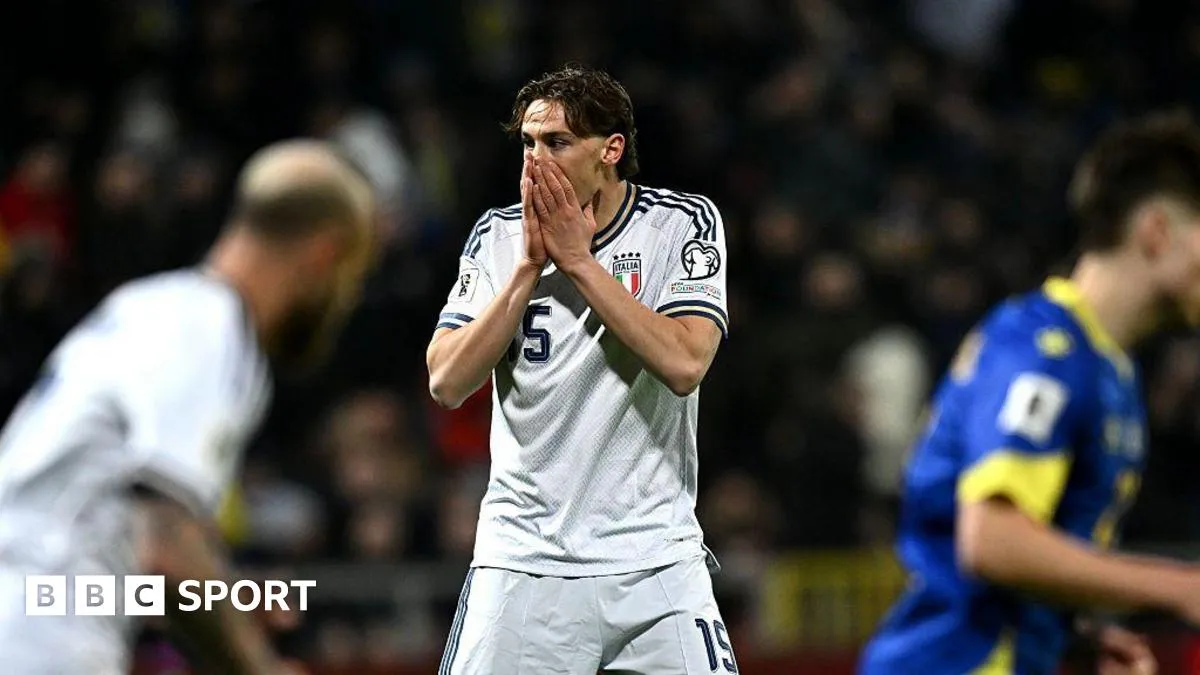
Italy has not qualified for the World Cup since 2014, marking a significant decline for a historically successful football nation. The latest setback came on March 31, 2026, when Italy faced Bosnia and Herzegovina at Stadion Bilino Polje in Zenica. In a match that was filled with tension and drama, Italy initially took the lead with a goal from Moise Kean in the 15th minute.
However, the match took a turn when Alessandro Bastoni was sent off in the first half, leaving Italy with ten men. Despite their numerical disadvantage, Italy managed to hold onto their lead until the 79th minute, when Haris Tabakovic scored the equalizer for Bosnia and Herzegovina.
The match proceeded to a penalty shootout, where Bosnia and Herzegovina converted all four of their penalty kicks. In stark contrast, Italy faltered, with Francesco Esposito and Bryan Cristante missing their attempts, sealing their fate and confirming their absence from yet another World Cup.
Gennaro Gattuso, the head coach of Italy, expressed his disappointment, stating, “It hurts, because we needed it for us, for all of Italy and for our movement. A blow that’s difficult to digest.” This sentiment was echoed by players, including Leonardo Spinazzola, who lamented that “Italian children will see another World Cup without Italy.”
This defeat marks the third consecutive World Cup that Italy has failed to qualify for, a stark contrast to their storied history, which includes four World Cup victories. Their last appearance in the tournament was in 2014 in Brazil, and since then, the team has struggled to regain its former glory.
The implications of this loss extend beyond just the current team; it raises questions about the future of Italian football. As Gattuso noted, the situation is becoming “difficult to digest,” and observers are left wondering what changes might be necessary to revive the national team’s fortunes.
As Italy grapples with this latest disappointment, Bosnia and Herzegovina celebrates its qualification for the World Cup for the second time in history. This victory not only highlights their growth as a footballing nation but also underscores the shifting dynamics in European football.
Looking ahead, the Italian football federation will need to assess its strategies and perhaps rethink its approach to nurturing talent if it hopes to return to the World Cup stage. The road to recovery will be long and challenging, but the passion for football in Italy remains strong.
Details remain unconfirmed regarding the immediate future of the coaching staff and potential player changes, but one thing is certain: the landscape of Italian football is at a crossroads.