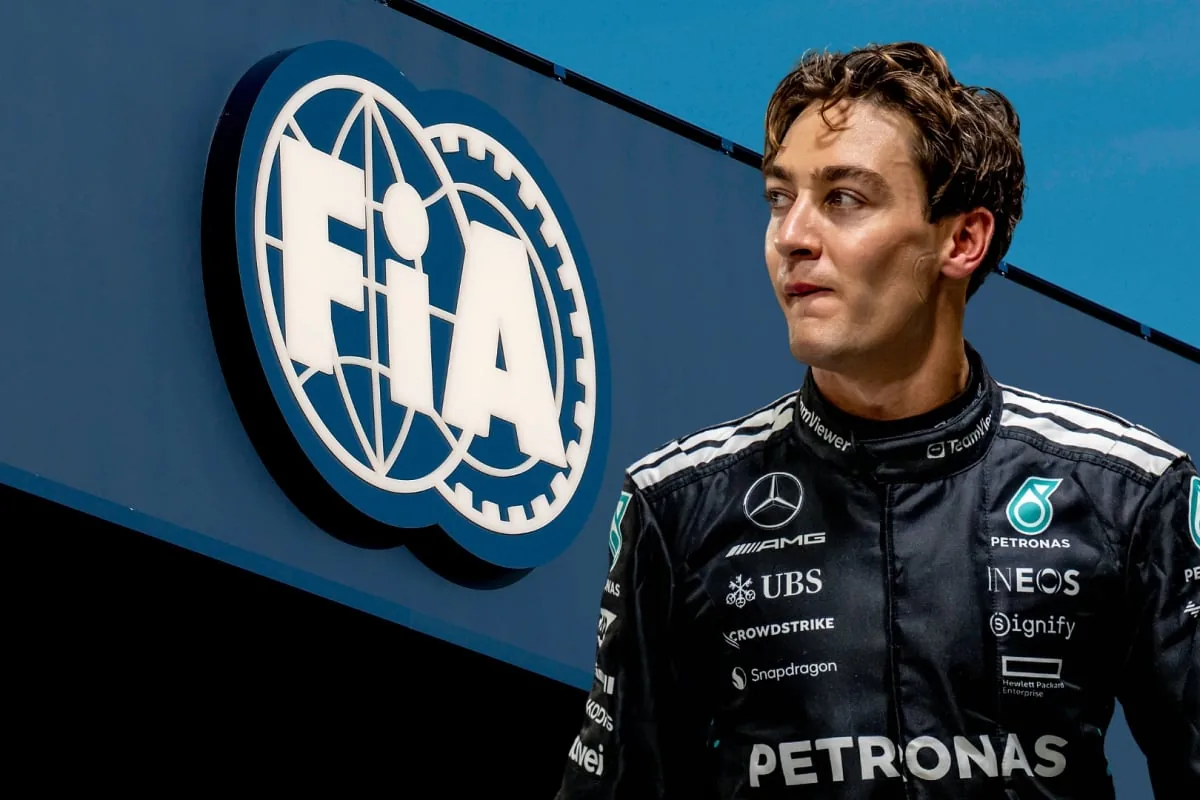
George Russell is set to postpone taking an engine change penalty in Formula 1 until an upgraded specification from Mercedes becomes available. This upgrade, known as ADUO, might not be ready until around the time of the United States Grand Prix.
Early season reliability issues have meant that both Russell and his teammate, Kimi Antonelli, have exceeded their allocated in-season component limits to complete the current campaign. Antonelli opted to take additional power unit components during the Italian Grand Prix, which resulted in him starting from 19th position, though he ultimately secured a victory in that race.
Strategic Delay for Upgraded Components
Initially, it seemed probable that Russell would incur his penalty at the subsequent race in Azerbaijan. The long straights of the Baku circuit were thought to offer an opportunity for him to advance through the field, similar to Antonelli’s performance.
However, Mercedes has reportedly decided to delay this switch. The team aims to align Russell’s engine change with the introduction of upgraded parts. This strategy is linked to an update to its power unit, made possible by an additional allowance under F1’s Additional Development and Upgrade Opportunities (ADUO) system.
This decision introduces further complexity regarding when Russell will receive a new power unit. He has already reached the maximum allowance for several components, leaving no room for new parts without incurring penalties. Specifically, he has maxed out his internal combustion engine, turbo, energy store (battery), and control electronics for the season.
Taking fresh components in the immediate upcoming races would trigger penalties. Furthermore, he would face an additional grid drop if he were to then switch to the ADUO-improved parts shortly after. Speaking at the Spanish Grand Prix, Russell indicated that the current plan is to combine his engine penalty with the ADUO upgrade, deeming it illogical to incur a double penalty.
Timing of the ADUO Upgrade
When questioned about not following Antonelli’s lead in taking a new engine for the Italian Grand Prix, Russell explained, “We were always going to take my penalty with the ADUO upgrade. Otherwise, if I took it there, I’d have to take it again. So it makes zero sense for me.”
Mercedes has not yet made a final decision on the exact introduction date for its ADUO upgrade. While it was initially anticipated for the next series of flyaway races, including Azerbaijan, Malaysia, and Singapore, sources now suggest it is more likely to appear for the triple-header event. This triple-header includes races in the United States, Mexico, and Brazil, commencing at Austin between October 23-25.
The upgraded specification, which is understood to feature an improved turbo, will also be accessible to Antonelli once Mercedes implements it. Antonelli did not opt for a complete power unit change in Italy; Mercedes instead limited his component replacement to the internal combustion engine, battery, and control electronics. This approach provides him with the flexibility to install a new turbo, MGU-K, exhaust, and other ancillary components without incurring penalties.
Any improvements to the specification introduced by the works Mercedes team must also be made available to customer teams. However, this is limited to a single unit for each customer team at the initial event where the upgrade is introduced.
Italian Grand Prix Incident Review
During the early stages of the race at Monza, Russell was involved in a close contest with Max Verstappen for the lead. Antonelli, who started from the back after overtaking Lewis Hamilton and the McLarens, also made significant progress.
The race experienced a temporary halt under a virtual safety car following Lance Stroll’s Aston Martin breaking down. Russell, who remained on older tyres, eventually lost the opportunity to win, while both Antonelli and Verstappen pitted for fresh tyres.
Russell was investigated for a potential yellow flag violation in the Variante del Rettifilo, ahead of Stroll’s incident. This involved a single yellow flag displayed before the activation of the virtual safety car. Stewards reviewed various data points, including car positioning data, marshal system records, video footage, live timing, and telemetry. They concluded that no penalty was warranted, noting that no yellow flag or steering wheel light was visible to the driver in the yellow flag sector. A green light panel was visible as the car neared the end of the sector, and telemetry indicated that the driver did reduce throttle input.
The decision to delay Russell’s engine penalty aligns with Mercedes’ strategy to introduce the ADUO-upgraded specification, potentially around the October 23-25 triple-header in the United States, Mexico, and Brazil.
Source: the-race.com